
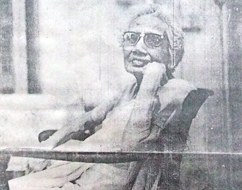
Seeta Chaudhuri
FounderFounder of Nari Seva Sangha
Seeta Chaudhuri is the founder of Nari Seva Sangha (1944)[1], an Indian non-profit working on women & children, education and livelihood from Kolkata.
Seeta Chaudhuri was an Indian social worker in Calcutta and the founding member and secretary of Nari Seva Sangha, established in 1944 to relieve women left destitute by the Bengal famine of 1943. She has been described as Bengal's Florence Nightingale.
Nari Seva Sangha began with community kitchens for destitute women and developed into a training and rehabilitation centre; it later took in women displaced by the partition of Bengal.
Nari Seva Sangha
The Sangha was founded in 1944, when large numbers of women in Bengal had been left without support by the famine of the preceding years, and its work expanded after the partition of Bengal in 1947 brought refugee women to Calcutta.
Its stated aim was to train, rehabilitate and make self-reliant the women and girls who came to it. Training was given in batik, block printing, dyeing and weaving, tailoring, embroidery, knitting, toy making, book-binding, cookery and food preservation, alongside general education. Residents generally stayed until they found other accommodation or married.
The organisation moved to its present premises in Kolkata in 1976. It continues to run a residential home for women in distress, a non-formal education school, a vocational training centre, a balwadi and primary school, and a working women's hostel.[2][3]
Nari Seva Sangha
Nari Seva Sangha was founded in 1944, when hundreds of women were left destitute by the Bengal famine and the partition that followed. Founder-secretary Seeta Chaudhuri — remembered as Bengal's Florence Nightingale — built it into a Jodhpur Park institution that runs a home for distressed women, non-formal education and vocational training schools, a Balwadi pre-primary and primary school for low-income children, and a working women's hostel, training residents until they become self-reliant and employed.
Nari Seva Sangha reports the following, on its own site:
- Working Women's Hostel houses 40 women, and the Balwadi serves 40 children from low-income families

Inspired by Seeta's work?
Support Nari Seva SanghaOther changemakers
See all → Badruddin AjmalAjmal Foundation
 K. Anji ReddyDr. Reddy's Foundation
 Kaifi AzmiMijwan Welfare Society
 Farida LambayPratham Education Foundation
 Kiran BediIndia Vision Foundation
 Kiran ModiUdayan Care
 Madhav ChavanPratham Education Foundation
 Matthew SpacieMagic Bus India Foundation
 Sanjay KumarAashray Adhikar Abhiyan (AAA)
 Dhondo Keshav KarveMaharshi Karve Stree Shikshan Samstha
 Kanuru Varalakshmi RaoSwami Sivananda Memorial Institute (SSMI)
 Mayur PatnalaNirmaan Organization