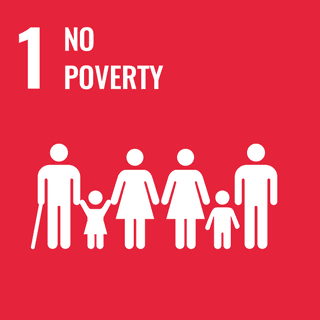
Goal 1: No Poverty
End poverty in all its forms everywhere.
743 organisations on Daan.org work in areas corresponding to this goal — Livelihood, Hunger. This is our mapping of causes to goals, not an assessment against the UN's indicators.
What Goal 1 asks for
Goal 1 is usually summarised as ending poverty, but the text of the goal is more specific than the slogan. It sets two different tests. The first is extreme poverty measured against an international poverty line, which is meant to disappear entirely by 2030. The second, and the harder one for a middle-income country like India, is poverty measured against each country's own national poverty line and in all its dimensions: the goal asks governments to at least halve the share of men, women and children living in poverty as their own country defines it. That second test is what makes Goal 1 relevant to households that are not starving but cannot absorb a hospital bill, a failed crop or a month without work.
The remaining targets describe the machinery that is supposed to keep people out of poverty rather than simply counting who is in it. One target asks countries to build social protection systems, including basic floors, that actually reach poor and vulnerable people. Another asks that poor people have equal rights to economic resources: basic services, ownership and control over land and other property, inheritance, natural resources, new technology and financial services including microfinance. A third target is about resilience, reducing the exposure of poor households to climate-related extreme events and to economic and environmental shocks, on the reasoning that a single flood or illness can undo a decade of slow gains. Two further targets deal with mobilising money and with writing pro-poor, gender-sensitive policy frameworks.
Goal 1 in India
India measures deprivation with more than income. NITI Aayog's National Multidimensional Poverty Index classes a person as poor if they are deprived on a third or more of twelve weighted indicators spanning health, education and standard of living. Its discussion paper, released in January 2024, reported that the multidimensional poverty headcount ratio fell from 29.17 per cent in 2013-14 to 11.28 per cent in 2022-23, with about 24.82 crore people moving out of multidimensional poverty over those nine years, and the largest absolute declines in Uttar Pradesh, Bihar, Madhya Pradesh and Rajasthan. The same paper credits a stack of programmes rather than any single one, because the index moves only when several deprivations fall together.
The main instruments are national in scale. The National Food Security Act, 2013 gives up to 75 per cent of the rural population and 50 per cent of the urban population a legal entitlement to subsidised foodgrain, with the eldest woman of the household aged 18 or above recorded as the head of household on the ration card. Pradhan Mantri Awaas Yojana - Gramin, launched on 1 April 2016, is building pucca houses for eligible rural families, and Pradhan Mantri Jan Dhan Yojana has taken bank accounts from 14.72 crore in March 2015 to 55.22 crore by June 2025, which is what makes direct benefit transfer possible at all. Non-profits tend to work in the gap between an entitlement existing and a household actually receiving it: helping people obtain ration cards, Aadhaar-linked accounts, pensions, disability certificates and scholarship claims; reaching groups that scheme lists routinely miss, such as homeless families, seasonal migrants and denotified tribal communities; and building the household-level income sources, through self-help groups, land rights work and skills training, that decide whether a family stays out of poverty once it has left it.
Indian NGOs working on No Poverty


Goonj
Cloth for Work — turning urban surplus into a rural development resource
72 million kgs of material handled (April 2014 – March 2025)


The Akshaya Patra Foundation
Unlimited food for education
Serves mid-day meals to over 2.35 million children every school day

Smile Foundation
Changing lives, restoring dignity
Reaches over 20 lakh (2 million) children and families every year

Pratham Education Foundation
Every child in school and learning well
Reaches 7 million children and youth in a typical year


SankalpTaru Foundation
Plant a tree, grow a tree
1,900,000 trees planted


Feeding India by Zomato
Working towards a hunger-free India
1.4 lakh+ children served daily


Self Employed Women's Association (SEWA)
Organising women workers for full employment and self-reliance
3.7 million women members


Magic Bus India Foundation
Moving children and youth out of poverty
4,079,228 adolescents reached (April 2025 - March 2026)


Udayan Care
Nurturing lives, regenerating dignity
76,000 youth trained through skilling programmes
NAAM Foundation
Actor-led foundation tackling farmer distress in Maharashtra
Movement for drought-affected farming families, started by Nana Patekar and Makarand Anaspure in September 201
Founded by Nana Patekar & Makarand Anaspure
Paani Foundation
Aamir Khan's foundation fighting drought in rural Maharashtra
5 million people impacted through water conservation and sustainable farming
Founded by Aamir Khan
Mijwan Welfare Society
Shabana Azmi-led society empowering rural girls in Uttar Pradesh
Working for the girl child and women of rural Awadh since 1993 — founded by poet Kaifi Azmi, led by Shabana Az
Founded by Shabana Azmi
Gautam Gambhir Foundation
Cricketer Gautam Gambhir's foundation for health and education
Community kitchens, education and healthcare initiatives to empower underprivileged children
Founded by Gautam Gambhir
Barefoot College
Training rural women as solar engineers and community leaders
Solar-engineer training for rural women spanning 90+ countries

Ekal Vidyalaya Foundation of India
One-teacher schools for rural and tribal children
89,039 single-teacher schools run in rural and tribal villages

Annamrita Foundation
ISKCON-linked mid-day meal programme for schoolchildren
12 lakh+ mid-day meals served daily

Robin Hood Army
Volunteer network redistributing surplus food to the hungry
158 million meals served to the less fortunate
Rise Against Hunger India
Fighting hunger through meal packaging and nutrition programmes
4.6 crore (46 million) meals packaged
No Food Waste
Recovering surplus food and redistributing it to the needy
15 million+ plates of surplus food served to the needy

Watershed Organisation Trust
Watershed development and climate resilience for rural India
6.93 million people reached across 7,124 villages
Samarthanam Trust for the Disabled
Empowering people with disabilities through education and livelihood
34,000 students received education support

EnAble India
Economic independence and dignity for people with disabilities
7,00,000 stakeholders impacted across 21 disability types since 1999
Habitat for Humanity India
Decent housing and disaster response for vulnerable families
57,816 homes built and repaired for low-income families

PRADAN
Enhancing rural livelihoods for the poorest communities
Questions about Goal 1
- What is the difference between SDG 1 and simply giving money to poor people?
- Cash transfers address the shortfall in income, which is only one of the things Goal 1 measures. The goal also asks whether a household has a social protection system to fall back on, secure rights over land and property, access to basic services and financial services, and some protection against shocks like floods and illness. A family can be above an income line and still be poor on several of those counts, which is why India's own measurement uses twelve indicators rather than one.
- Has poverty in India actually fallen?
- By India's official multidimensional measure, yes and substantially. NITI Aayog reported in January 2024 that the multidimensional poverty headcount ratio fell from 29.17 per cent in 2013-14 to 11.28 per cent in 2022-23. That measure counts deprivations in health, education and living standards; it is not the same thing as an income poverty line, and different measures give different pictures.
- If government schemes already cover food, housing and bank accounts, what is left for an NGO to do?
- Mostly the last mile and the people the lists miss. Entitlements under the National Food Security Act or a housing scheme require documents, a verified address and a working grievance route, and households without any of those are precisely the poorest. Non-profits also work on things no scheme delivers directly, such as household livelihoods, women's collectives and legal help with land and tenancy.
Sources
- [1] Goal 1: End poverty in all its forms everywhere — United Nations Department of Economic and Social Affairs. Source
- [2] 24.82 crore Indians escape Multidimensional Poverty in last 9 years — Press Information Bureau, NITI Aayog (15 January 2024). Source
- [3] National Food Security Act, 2013 — Department of Food and Public Distribution, Ministry of Consumer Affairs, Food and Public Distribution. Source
- [4] Enhancing Ease of Living: India's Journey to Viksit Bharat — Press Information Bureau, Government of India (20 June 2025). Source