
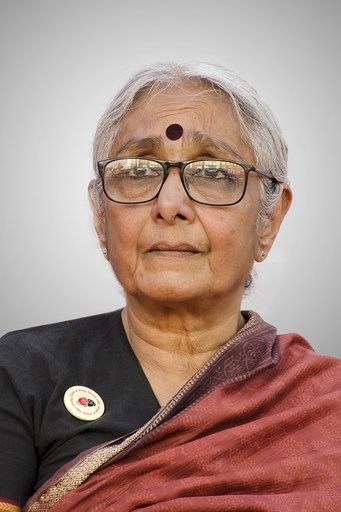
Aruna Roy
FounderFounder of Mazdoor Kisan Shakti Sangathan (MKSS)
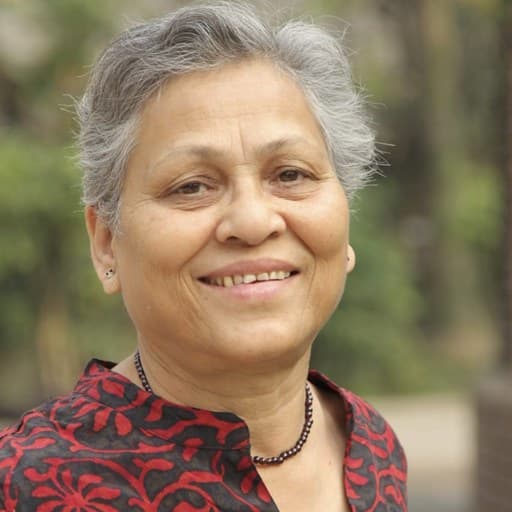
Photo: Wikimedia (CC BY-SA)
Aruna Roy is the founder of Mazdoor Kisan Shakti Sangathan (MKSS) (1990)[1], an Indian non-profit working on human rights and livelihood from Devdungri.
Aruna Roy (born 26 May 1946) is an Indian social activist and former civil servant who co-founded the Mazdoor Kisan Shakti Sangathan (MKSS), a non-party organisation of workers and peasants based in central Rajasthan. She is closely associated with the movement that led to the passage of India's Right to Information Act in 2005.
Roy resigned from the Indian Administrative Service in 1974 to work in rural Rajasthan, and has since campaigned on minimum wages, transparency in public spending, the right to work and the right to food.
Early life and education
Roy was born in Madras (now Chennai) on 26 May 1946 to Hema and E. D. Jayaram. She trained for two years at the Kalakshetra academy in Bharatanatyam and Carnatic music, and attended Bharatiya Vidya Bhavan until the age of sixteen. She took a BA in English literature at Indraprastha College for Women and an MA in English literature at the University of Delhi in 1965, followed by a master's in public administration at the National Academy of Administration.
She married Sanjit Roy, founder of the Social Work Research Centre at Tilonia (later known as Barefoot College), in 1970.
Career
Roy qualified for the Indian Administrative Service in 1967, one of ten women selected that year, and served in Tamil Nadu and Delhi, including as secretary to the Lieutenant Governor of Delhi in 1973. She resigned in 1974, saying the service perpetuated feudal and colonial values.
From 1974 she worked at the Social Work Research Centre in Tilonia, Rajasthan, and took up cases of minimum wage violation that led to a Supreme Court ruling in 1983. In 1987 she moved to the village of Devdungri with Nikhil Dey and Shankar Singh, and on 1 May 1990 the three founded the Mazdoor Kisan Shakti Sangathan at Bhim in Rajsamand district. MKSS has no formal membership fees, constitution or designated leader.
MKSS developed the jan sunwai, or public hearing, at which official expenditure records are read aloud and villagers testify to what was actually delivered. The method underpinned the campaign of the National Campaign for People's Right to Information, which culminated in the Right to Information Act of 2005. Roy also worked on the National Rural Employment Guarantee Act 2005, the Right to Food campaign, the Pension Parishad campaign for universal non-contributory pensions, and whistleblower protection.
She served on India's National Advisory Council until she resigned in 2006, was president of the National Federation of Indian Women from 2008 to 2024, and was appointed Professor of Practice in Global Governance at McGill University in 2016. With the MKSS collective she wrote The RTI Story: Power to the People (2018), and with Nikhil Dey and Rakshita Swamy, We the People: Establishing Rights and Deepening Democracy (2020).
Recognition
Roy and MKSS received the Times Fellowships Award in 1991. She was awarded the Ramon Magsaysay Award for Community Leadership in 2000 for empowering villagers to exercise the right to information, and the Lal Bahadur Shastri National Award for Excellence in Public Administration, Academia and Management in 2010. Time magazine named her among its 100 most influential people in 2011, and she was included in the BBC 100 Women list in 2024.[2][3][4][5]
Mazdoor Kisan Shakti Sangathan (MKSS)
Mazdoor Kisan Shakti Sangathan is a grassroots workers' and farmers' organisation headquartered in Devdungri, Rajasthan, founded in 1987. It pioneered public hearings and social audits that fed directly into the drafting of India's 2005 Right to Information Act and later helped institutionalise social audits under MGNREGA, and it continues to campaign on transparency, wage justice and democratic accountability.


Inspired by Aruna's work?
Support Mazdoor Kisan Shakti Sangathan (MKSS)Other changemakers
See all →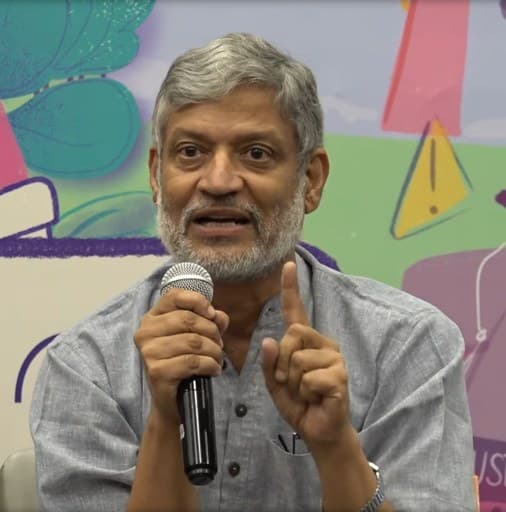 Nikhil DeyMazdoor Kisan Shakti Sangathan (MKSS)
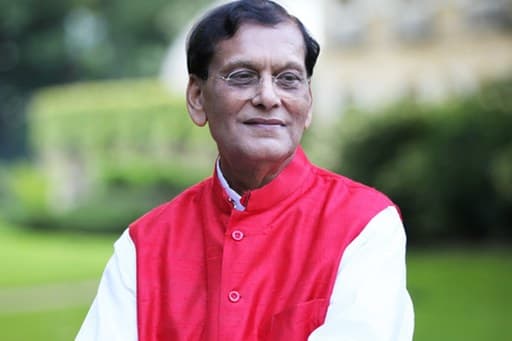 Bindeshwar PathakSulabh International
 Sanjay KumarAashray Adhikar Abhiyan (AAA)
 Kalki SubramaniamSahodari Foundation
 Madhavi KukrejaVanangana
 Arbind SinghNIDAN
 C. SubramaniamNational Foundation for India (NFI)
 Devaki JainNational Foundation for India (NFI)
 Krishnavatar SharmaAajeevika Bureau
 M. S. SwaminathanNational Foundation for India (NFI)
 Monisha BehalNorth East Network
 R. BalasubramaniamSwami Vivekananda Youth Movement